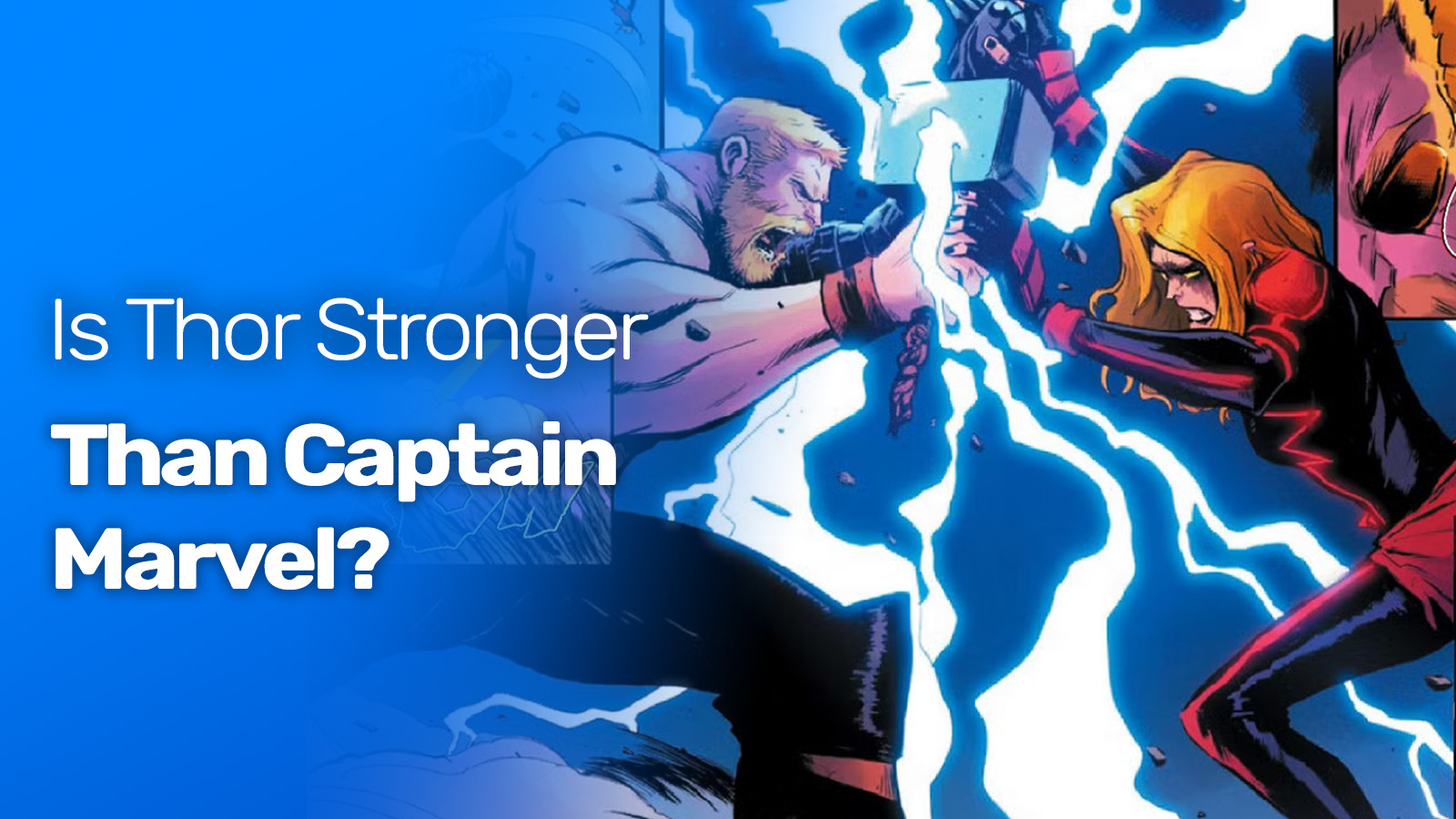
Is Thor Stronger Than Captain Marvel?
This article is an editorial piece created by VeVe and is not affiliated with, endorsed, or approved by Marvel or any licensors or partners. The views expressed are solely those of VeVe and do not reflect those of any licensors or rights holders.
Is Thor Stronger Than Captain Marvel?
For most fans asking “is Thor stronger than Captain Marvel?”, the answer is fairly straightforward: Thor generally has the edge in raw physical strength, particularly in Marvel Comics. While the debate can get more complicated depending on how you define “power,” Thor’s reputation as one of Marvel’s premier heavy hitters is well-earned. Captain Marvel is undeniably one of the most powerful heroes in the universe, but her strengths lie in a different category—one that doesn’t always translate to pure, brute force.

What Does “Stronger” Mean in Marvel?
To understand why this question keeps coming up, it helps to clarify what “stronger” actually means in a Marvel context. Fans often use the term interchangeably, but there’s an important distinction between physical strength and overall power. Physical strength refers to lifting ability, striking force, and durability in close combat, while overall power includes things like energy projection, flight, speed, and survivability in extreme environments. Marvel itself separates these ideas in its character profiles, which is why one character can be physically stronger while another may still win in a broader fight scenario.
Why Thor Is Usually Stronger
Thor’s advantage becomes clear when you focus strictly on physical strength. As the Asgardian God of Thunder, he operates on a level that very few heroes can match. His baseline abilities include immense strength, near-limitless stamina, and durability that allows him to endure blows from some of the most powerful beings in the Marvel Universe. He has gone toe-to-toe with characters like the Hulk and consistently held his own, which is often used as a benchmark for top-tier strength. Thor isn’t just strong for a hero—he’s strong even by god-level standards.
That strength is further reinforced by his connection to Mjolnir. While the hammer is often associated with lightning and elemental control, it also plays a symbolic role in defining Thor’s identity. Mjolnir represents worthiness, power, and control, and it amplifies the sense that Thor is a character built around physical dominance. This is a big reason why thor collectibles tend to focus so heavily on the hammer itself, whether through detailed replicas or statues that capture Thor mid-strike. The imagery always ties back to that idea of overwhelming strength and presence.
Captain Marvel’s Strength and Energy Advantage
Captain Marvel, by comparison, brings a different kind of power set. After becoming a human-Kree hybrid, Carol Danvers gained enhanced strength, durability, and stamina, putting her well above most heroes in terms of physical capability. However, her real advantage lies in her ability to absorb and manipulate energy. She can channel that energy into powerful photonic blasts, sustain herself in space, and dramatically increase her output when fully charged.
This is where the debate starts to shift. While Thor may be stronger in a straightforward sense, Captain Marvel’s energy-based abilities give her a much higher ceiling in terms of overall power. If she’s fully charged and operating at peak levels, she can rival or even surpass Thor in certain situations. But that kind of performance is often conditional, whereas Thor’s strength is consistent and always available. He doesn’t need to power up or absorb external energy to operate at an elite level—he simply is that powerful by default.
Thor vs Captain Marvel in Comics vs MCU
Another reason this discussion can feel inconsistent is the difference between comic portrayals and the Marvel Cinematic Universe. In the comics, Thor’s strength advantage is clear and well-established, with his character consistently portrayed as a mythological powerhouse. In the MCU, however, Captain Marvel has been described as one of the most powerful heroes overall, which shifts the conversation toward total capability rather than raw strength.
This difference in framing explains why fans often reach different conclusions. If you’re comparing physical strength using comic logic, Thor comes out on top. If you’re looking at overall power in a cinematic context, Captain Marvel’s versatility becomes a much stronger argument. It’s less about contradiction and more about perspective—what you’re measuring determines the answer.
What This Means for Thor Collectibles
All of this ties directly into how these characters are represented in marvel collectibles. Thor’s appeal is rooted in his physicality and mythological presence, which is why thor collectibles often emphasize weight, impact, and iconic imagery. Statues and digital collectibles tend to capture him in grounded, powerful stances, often surrounded by lightning or gripping Mjolnir as if it’s an extension of his strength. There’s a sense of heaviness and permanence to Thor that translates perfectly into collectible form.
Captain Marvel collectibles, on the other hand, usually lean into motion and energy, highlighting her flight and cosmic power. Both characters are visually striking, but they represent very different interpretations of strength, and that difference is reflected in how they’re designed and collected.
Final Verdict: Is Thor Stronger Than Captain Marvel?
In the end, the answer depends on how you frame the question, but if you’re asking strictly about raw physical strength, Thor is almost always the stronger of the two. Captain Marvel may reach higher peaks in terms of overall power, especially when energy absorption comes into play, but Thor’s baseline strength places him firmly among Marvel’s elite. It’s that consistent, undeniable power that defines his character—and why he continues to stand out as one of the most iconic figures in the Marvel Universe, both on the page and in the world of collectibles.