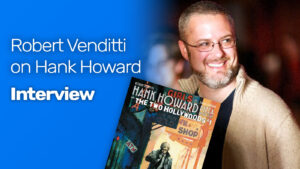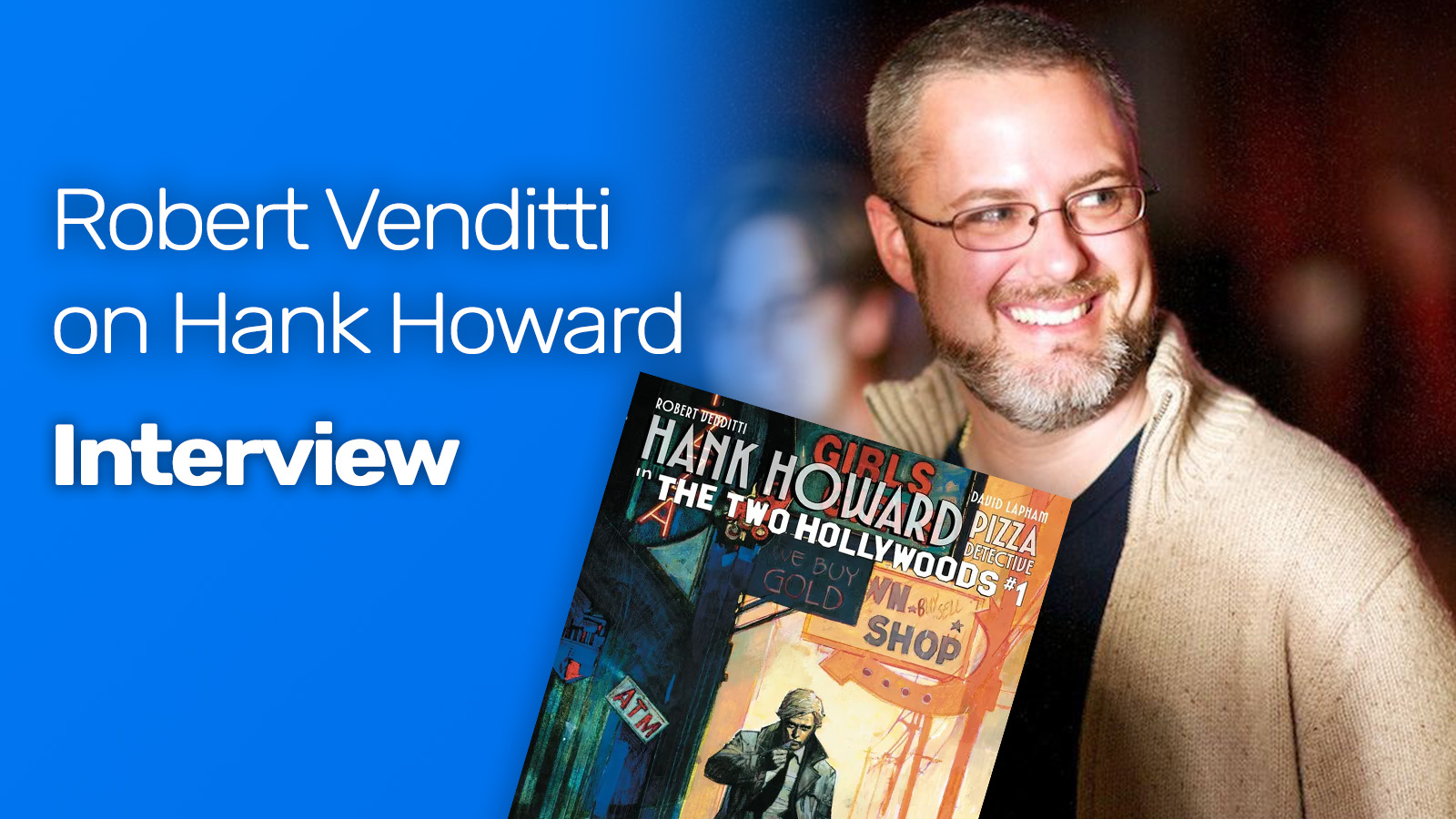
Robert Venditti on Hank Howard: Pizza Detective (Interview)
Robert Venditti on Hank Howard: Pizza Detective (Interview)
Robert Venditti has written everything from high-concept sci-fi to grounded crime—and sometimes, gloriously, both at once. In his work with Bad Idea and beyond, he’s built a reputation for characters who feel human even in absurd situations: time-travel, android lives, priests and gangsters… and yes, a detective who treats pizza crime like the highest-stakes case of his life.
We sent Robert a handful of questions about Hank Howard: Pizza Detective, noir inspirations, character-first storytelling, digital comics, and adapting comics for the screen. We had a lot of fun reading his replies, so settle in, grab a slice, and enjoy.
In high school I did work at a Chuck E. Cheese (the E is for ‘Entertainment’), so I know my way around a pizza restaurant.
Robert Venditti Tweet
This interview has been edited for length and clarity.
VEVE: Your protagonists in Bad Idea’s series are often fighting against the odds. Are there any situations that a Robert Venditti character has found themselves in you think you’d most likely excel in—or perhaps another environment you might not have written yet?
ROBERT VENDITTI: Of all those characters and situations, Hank Howard is the only one I’d even come close to. I’m not a time-traveling mercenary or an ex-Navy SEAL, but in high school I did work at a Chuck E. Cheese (the E is for “Entertainment”), so I know my way around a pizza restaurant. Several of Hank’s short stories—“The Counterfeiter’s Gamble”, “The Bad Goods”, and “The Inside Game”—are inspired by real events that happened during my time there.
VEVE: Hank Howard: Pizza Detective contains styles and themes that remind readers of film noir. Were any particular films, actors or directors from that era an influence?
ROBERT VENDITTI: I’m not very well-versed in noir films. I know the film posters and the famous still photographs that everyone has seen, but I haven’t watched many films in the genre outside Chinatown.
“Hank is actually much more inspired by Edgar Allan Poe’s ‘The Tell-Tale Heart.’”
Robert Venditti Tweet
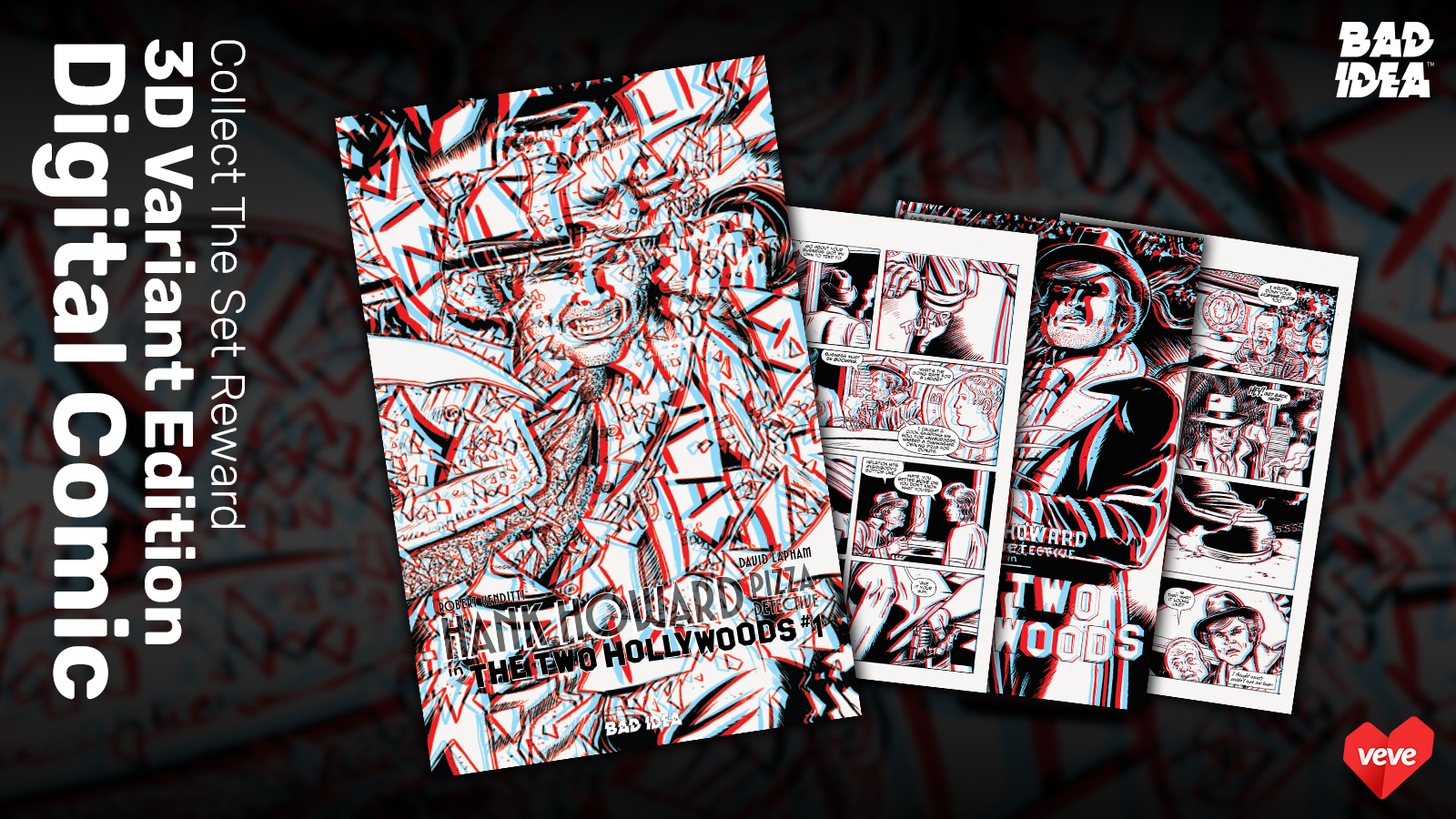
It’s always stuck with me because it was the first time I can remember reading an unreliable narrator. Hank started with the idea of a detective who takes pizza crime completely seriously, even though everyone around him thinks he’s absurd. My hope is the reader goes from thinking they can’t trust Hank’s point of view, to realizing he’s been right all along. Hank is all heart—it’s just that he’s given his heart to pizza. In later stories like “The Two Hollywoods” and “A Slice of Life,” we start to peel back those layers.
None of this works without David Lapham. He can make Hank absurd and endearing at the same time, while landing both the emotion and the humor. His storytelling is unparalleled. Collaborating with David means we can fit a ton of story into a one-shot, or even an 8-page short. It’s a joy to watch him work.
VEVE: When it comes to characterization and storyline, which for you comes first in the creative process: a situation or premise that helps to shape the cast, or is the setting and world built around the character concepts?
ROBERT VENDITTI: Stories come together in all kinds of different ways. Sometimes it starts with a character (a pizza detective), sometimes a plot (a priest hears the final confession of a dying gangster), and sometimes a high concept (a future in which everyone experiences life through android representations of themselves). Whatever hits me first, I sit down with a pen and journal to figure out everything else.
But no matter where it starts, character is the most important part.
“Plot, high concept, and theme don’t matter if the audience doesn’t have an engaging, relatable character to ground them.”
Robert Venditti Tweet
VEVE: As a writer, what benefits do you see digital bringing to this new age of comic books and storytelling?
ROBERT VENDITTI: I’m not very tech-savvy. For my reading experience, I prefer ink on paper, mostly because I already spend so much of my workday typing on a screen. But as a creator, digital is incredibly useful for referencing previous issues on a laptop or tablet. While writing new stories or sending current ones to the printer, I’m constantly checking earlier issues to make sure conversations, plot threads, and continuity line up.
Digital makes everything easier to access, especially if I’m traveling while working, which happens often. Ultimately, I want the audience to have my stories in whatever format works for them—print or digital.
VEVE: Ordained isn’t your first page-to-screen adaptation (with Bruce Willis starring in Surrogates). How much creative input do comic creators usually get on adaptations?
ROBERT VENDITTI: Every situation is unique. With Surrogates, that was my first comic book series. I was a new writer, and that’s not the kind of resume that leads a studio to hand over the reins to an $80 million production. I also never want to come across as managing other people’s creativity. The story already existed as a book the way we wanted to tell it. If someone wants to adapt it, I want them to have the freedom to follow their own inspiration. I served as a consultant whenever they asked, but I never tried to insert myself into the process.
With Ordained, because of my relationship working with Derek Kolstad on Planet Death, I’ve talked with him about the story and the characters. But Derek’s in the lead. He’s an amazing talent who doesn’t need anyone reading over his shoulder.
VEVE: And finally—what pizza are you ordering at Big Caligula’s?
ROBERT VENDITTI: My go-to slice is pepperoni and meatball. It’s important to understand I’m saying “meatball” and not “ground beef”—ground beef on pizza is a hard pass.
Any savvy pizza connoisseurs who’ve been paying attention already know that Hank’s go-to slice at Big Caligula’s is sausage and cheese, and the sausage looks like rabbit pellets instead of being sliced. That’s a clear indication that Big Caligula’s is a ground-beef joint, not sliced-meatball. So, if I’m eating at Big Caligula’s, it’d be just pepperoni—simple and hard to get wrong. Maybe some onion, but probably not, because I don’t usually trust the produce at a ground-beef type of place.
In reality, I wouldn’t eat there. I’d eat at a true pizza place, where I’m open to pretty much anything. There’s this place in New York City I like to go where you can get a slice with broccoli rabe. I’ll get a nice white pizza if it’s on the menu and I want something a little heavier. I generally don’t do sliced tomatoes or mushrooms because they cook off too much water onto the cheese, but if there’s nothing else around or I’m sharing with a vegetarian, I’ll deal with it.
I know I said “pretty much anything,” but that’s within reason. I’m not eating buffalo chicken or barbecue sauce on pizza, I don’t care if I just got rescued off a desert island. However, my mom makes a breakfast pizza with pepperoni, breakfast sausage, and egg that’s a total homerun, so I’m not afraid to get outside the box.
“None of this applies to Chicago-style deep-dish. I don’t understand how that ever became a thing.”
Robert Venditti Tweet
About as far as I’m willing to go in that direction is Detroit style. At the opposite end of the spectrum, I don’t want a thin crust either. If I want to eat crackers, I’ll stop off for some Saltines.
The pizza landscape doesn’t need to be so complex. All I want is a nice slice of Neapolitan, cooked enough for the bottom to have a good crisp to it. Which makes sense because the Vendittis came to America on a boat out of Naples. Neapolitan is in my blood.
Huge thanks to Robert Venditti for taking the time to answer our questions and for treating pizza with the gravity it deserves. Whether you’re here for Hank Howard’s dead-serious pursuit of pizza crimes, the Poe-inspired character work, or the behind-the-scenes reality of adaptations, Robert’s approach stays consistent: start with character, and everything else follows.
If you haven’t yet, check out Hank Howard: Pizza Detective available on VeVe comics—and keep an eye out for more creator interviews coming in the future.